

See clearly again thanks to modern treatment methods for cataracts.

Over the course of life, the eye’s natural lens loses fluid. Proteins begin to dominate within the lens, leading to clouding. Between the ages of 52 and 64, around 50% of the population develop cataracts. Between 65 and 75, this number rises to over 90%. In principle, however, cataracts can occur at any age.
Cataracts often go unnoticed at first, as the brain adapts to the gradual changes. However, many people experience worsening vision despite wearing glasses. This may present, for example, as increased glare at night, especially on wet roads (the cloudy lens scatters light). In such cases, a new pair of glasses will no longer help.
With our modern treatment techniques, the old, cloudy lens is removed and replaced with a new artificial lens. This new lens lasts a lifetime. This “minimally invasive” procedure is very gentle on the eye and is one of the most commonly performed surgeries worldwide.
Your two options when deciding on cataract surgery
We perform cataract surgery using state-of-the-art techniques and methods. The procedure itself is always standardized. However, as a patient, you can influence the likelihood of achieving good vision after surgery.
The quality of vision afterward depends, among other factors, on the surgical technique and the type of lens used.
You therefore have two decisions to make:
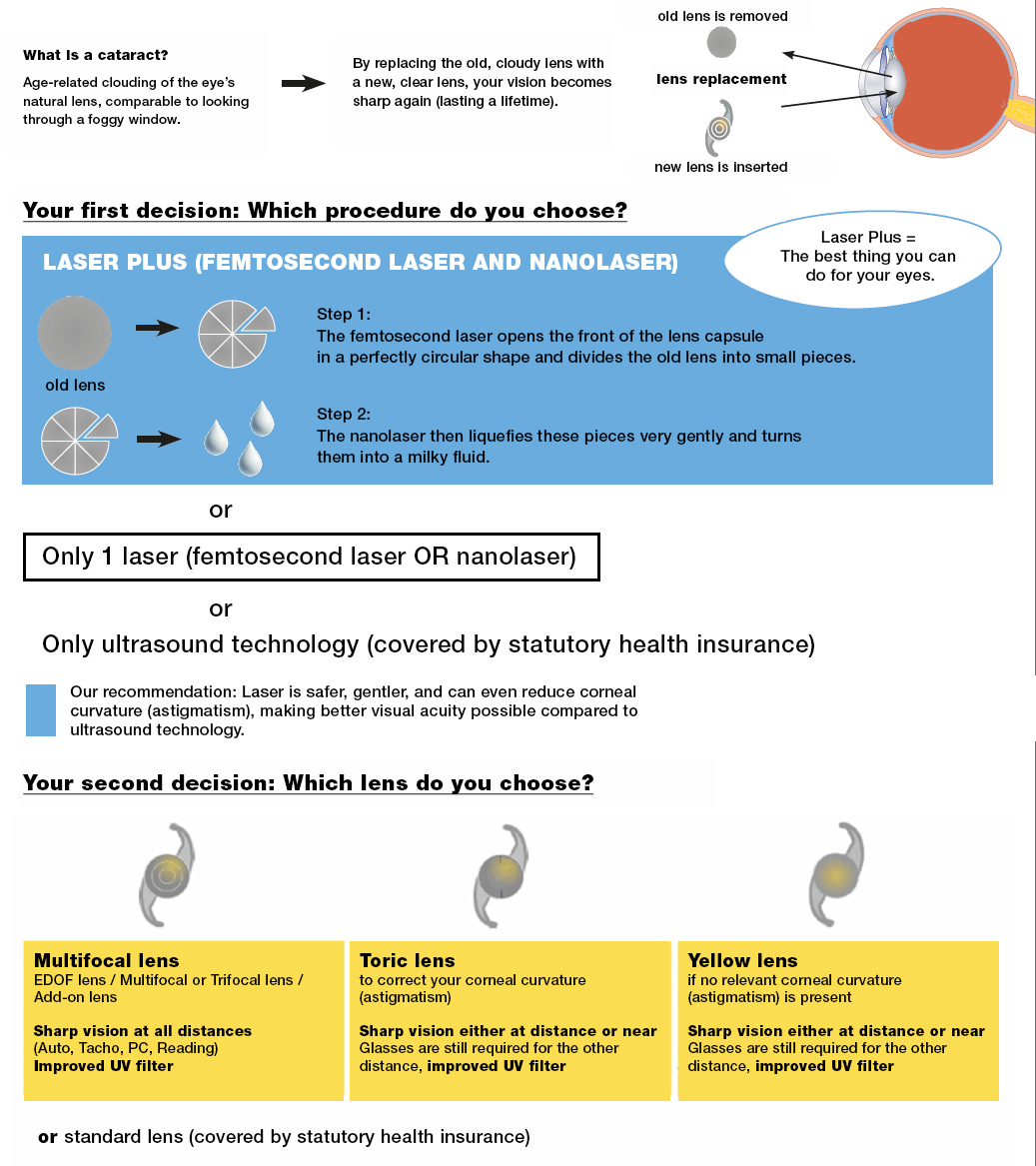
Our recommendation: Laser Plus and a premium lens
Most commonly chosen: laser treatment and a premium lens.
Satisfaction guarantee: With laser treatment and a premium lens, you receive a lifetime of free follow-up correction—if desired and necessary.
“You invest roughly the same as in a dental implant – and only once in a lifetime for your eyesight!”
Your two options when deciding on surgery (for those who want more details)
Your first decision: Which procedure do you choose?
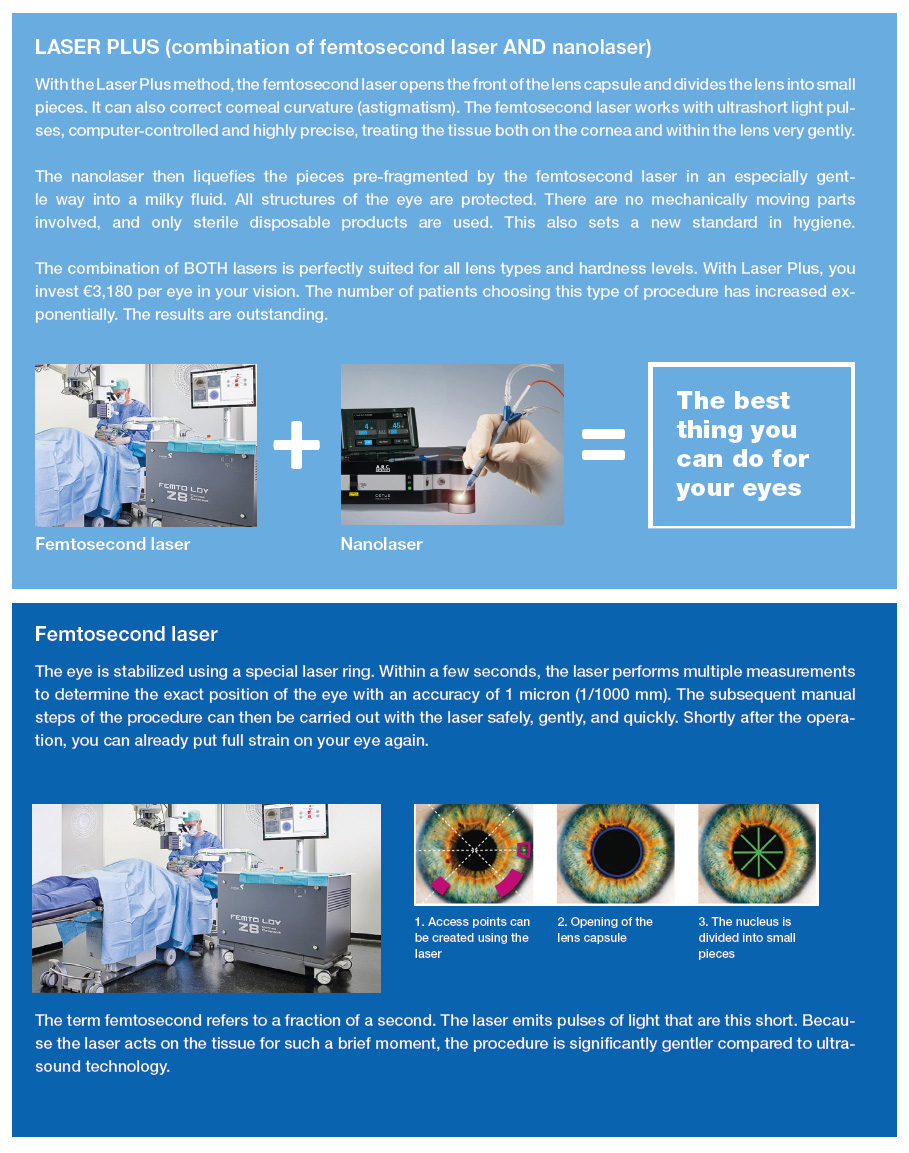
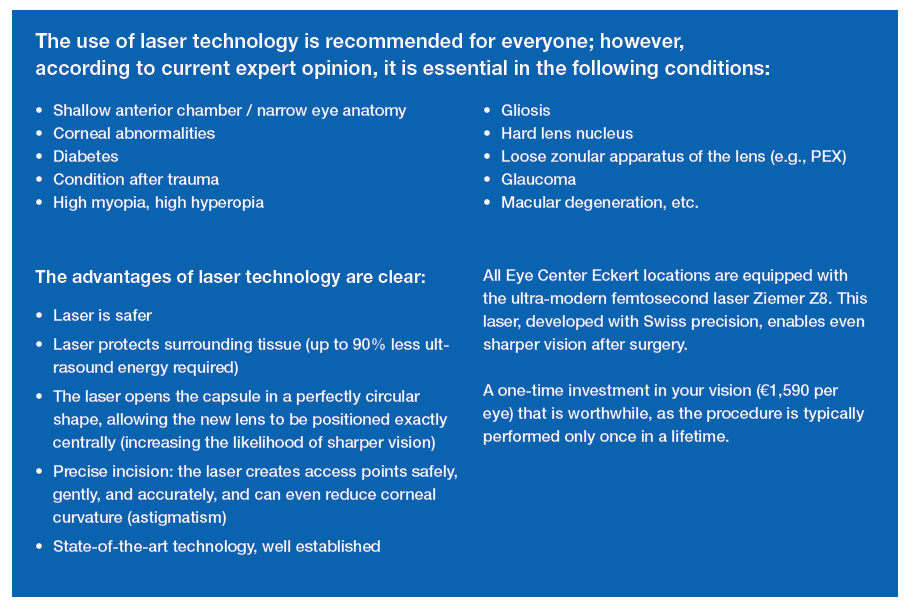
Ultrasound technique (covered by statutory health insurance)
Small incisions are made at the edge of the cornea using a scalpel, through which a curved needle is inserted into the eye. With this, the surgeon manually opens the anterior lens capsule (capsulorhexis technique).
The lens is then broken up and removed using ultrasound. Afterwards, a foldable artificial lens is implanted into the eye.
• The surgeon opens the eye with a scalpel and manually opens the anterior lens capsule using a capsulorhexis technique (with a small hook)
• The lens is fragmented exclusively using ultrasound energy
• Disadvantage: Tissue may be affected by the ultrasound energy (potential impact on the cornea, retina, and surrounding structures)
Your second decision: Which lens do you choose?
Premium lenses are lenses that, compared to standard lenses covered by statutory health insurance, offer additional features that can provide better visual quality well into old age. All premium lenses are aspheric, resulting in improved image quality.
Statutory health insurance generally does not cover premium lenses or the necessary preoperative examinations, whereas private health insurance usually does. Currently, most patients choose a premium lens.
The following types of lenses are distinguished:
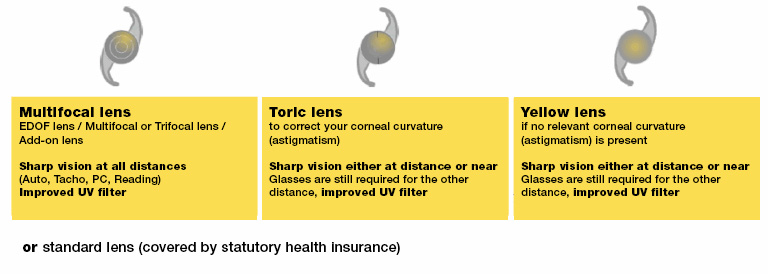
In addition to the properties of yellow and toric lenses, these lenses allow vision at distance, intermediate range, and near. This means your daily life can finally be free from glasses! More and more patients are choosing multifocal lenses—for good reason. You can save the cost of countless pairs of glasses well into old age.
EDOF lens (Extended Depth of Focus)
In addition to the properties of yellow and toric lenses, this type enables vision at distance, intermediate range, and a functional near range. Learn more about the popular EDOF lens here.
Multifocal / Trifocal lens
The trifocal lens is an advancement of the multifocal lens. It allows clear vision at all distances (far, intermediate, and near). Learn more about the popular trifocal lens here.
Add-on lens = Liberty System
The Liberty System consists of two lenses and offers similar properties to a trifocal lens. However, each eye is given a different addition: one eye is optimized more for distance vision, while the other is optimized more for near vision.
In addition to the properties of the yellow lens, this lens also corrects your astigmatism. Vision becomes even sharper, and disturbing light phenomena—such as glare from oncoming traffic while driving—are reduced. However, you will still need glasses for a specific distance.
You will not have yellow eyes, and your vision will not appear yellow—the lens is simply named that way. A blue-light filter protects your visual center from harmful short-wave UV radiation. Image quality is improved, and vision becomes more comfortable and sharper. However, you will still need glasses for a specific distance.
Do all of the above-mentioned lenses have a UV filter?
Of course, all of the above-mentioned lenses have a UV filter, which is important for protecting your macula.
Experience shows that most patients are only truly satisfied once both eyes have been operated on. Imagine buying just one new shoe—this foot would quickly become overloaded. The same applies to the first eye. Optimal vision can only be achieved once both eyes have been treated.
Optimal lighting conditions are essential for the best possible vision. In the initial period, regularly moisturizing the eye surface with artificial tears can be helpful. Nutritional supplements may also support the healing process (available at every Augenzentrum Eckert).
- Lens calculation using laser technology (IOL Master)
- Corneal surface mapping (topography)
- Laser-based high-resolution imaging of the visual center (OCT)
- Lens calculation using laser technology (IOL Master)
- Laser-based high-resolution imaging of the visual center (OCT)
- Lens calculation using laser technology (IOL Master)
Upon explicit request, we also offer the option to perform both the preoperative measurements and the surgery completely free of charge. However, we—and all professional societies—strongly advise against this, as visual outcomes are generally not optimal in such cases.
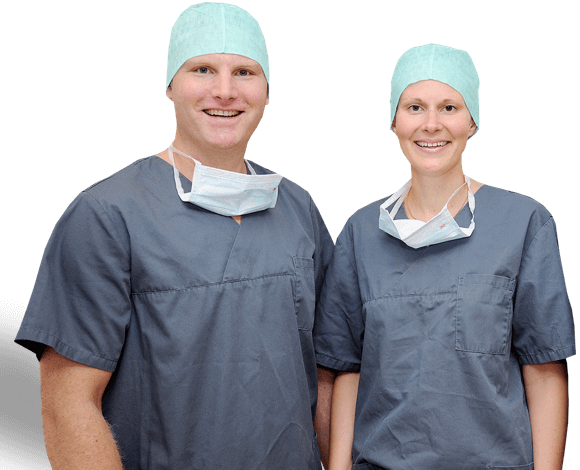
We would be happy to advise you.
Good reasons to choose Augenzentrum Eckert
Our goal is to provide you with the best possible medical care using the latest technology. Currently, over 95% of our surgical patients recommend us to others, according to our most recent surveys.
With us, every surgical patient receives not just one opinion, but a consensus formed by our entire medical team. In regular team meetings, each surgical case is reviewed again, and findings are carefully compared.
Our doctors are committed to treating every patient as if they were a member of their own family.
If you are satisfied, we would be delighted if you recommend us to others!
Frequently asked questions about cataracts
- Improved visual acuity after surgery
- Reduction of intraocular pressure
- With the appropriate lens and surgical method: independence from glasses
- Significantly reduced glare at night when driving
- Significantly lower risk of dementia and depression
- Reduced risk of falls and accidents
- Increased life expectancy
- Greater sense of well-being
Our goal is to provide you with the best possible medical care using the latest technology. Currently, over 95% of our surgical patients recommend us to others, according to our most recent surveys.
With us, every surgical patient receives not just one opinion, but a consensus formed by our entire medical team. As a rule, each patient is examined again by a second doctor before surgery. In addition, every surgical case is reviewed in regular team meetings, and findings are carefully compared.
Our doctors are committed to treating every patient as if they were a member of their own family.
Of course, you are welcome to switch—no referral is required.
Do not eat for 6 hours before the procedure and do not drink for 2 hours beforehand. Please do not wear any makeup.
In medically justified cases, a shuttle service is available to take you to the surgical center and safely bring you back home for a fee.
No, you do not need to stop your medications—even blood thinners can be continued.
Thanks to the gentle and modern surgical techniques, a visit to your general practitioner is not necessary beforehand.
Unfortunately, not all practices and clinics offer premium lenses and surgery with femtosecond or nano lasers. However, at Augenzentrum Eckert, we have made it our goal to provide our patients with the best possible treatment methods—so that you receive optimal care.
In 99.9% of patients, the desired postoperative refraction is achieved. However, each eye heals differently. If the intended diopter value is not reached and this is bothersome for you, there is always the option to correct the remaining refractive error with corneal laser treatment. In this case, the cost would be €800 per eye.
For patients with statutory health insurance: generally no.
For privately insured patients: generally yes.
Approximately 5–8 minutes.
The type of anesthesia is discussed individually with each patient. It is important that the procedure is monitored by an anesthesiologist, who is always present at Augenzentrum Eckert.
Approximately 40 surgeries are performed per day at Augenzentrum Eckert.
- Preoperative examination
- Day of surgery
- Brief follow-up check the next day
- A drop schedule reminds you to use your eye drops
For this purpose, there are so-called patient ambassadors. These are patients who have already undergone surgery at Augenzentrum Eckert and whom you can contact at any time. Simply ask our staff for more information.
Of course, yes. You can choose between the following types of anesthesia:
- Topical anesthesia (eye drops)
- Local anesthesia
- Short general anesthesia
Just a few days after the surgery, you can resume full physical activity and go to the sauna again.
A secondary cataract is a clouding of the lens capsule (not the lens itself!). This clouding can be removed at any time during a consultation using a laser, without any physical contact.
The new lens lasts a lifetime and never needs to be replaced. However, if necessary, it can of course be exchanged.
The complication rate is extremely low. In rare cases, fluid accumulation may occur after surgery (macular edema). However, this usually resolves with the use of eye drops.
A somewhat more common occurrence is the so-called secondary cataract. This is a clouding of the posterior lens capsule. Small cells that remain after surgery can multiply and slightly cloud the new artificial lens. This can be treated at any time in any of our practices with a painless procedure that takes only a few minutes.
Blood thinners do not need to be discontinued with us.
The current standard is so-called microsurgery. This means that the instruments are microscopically small in order to avoid any trauma to the eye. First, the anterior capsule is opened using a technique called capsulorhexis, after which the lens nucleus is fragmented using ultrasound (phacoemulsification). The new artificial lens can then be implanted.
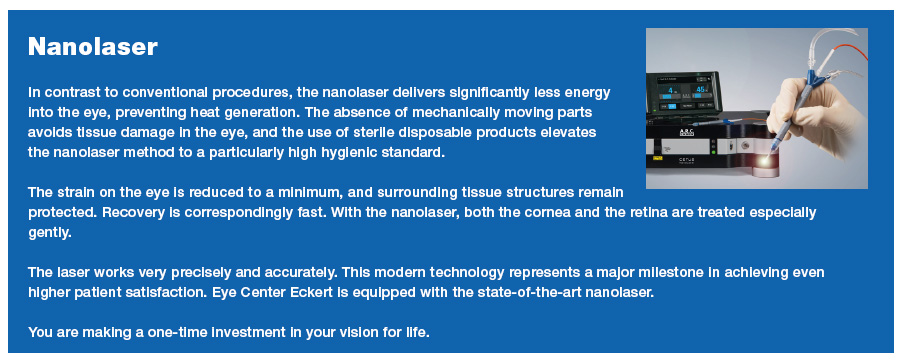
Of course, at our center, cataract surgery can also be performed using laser technology.
After a preoperative examination—including pupil dilation and inspection of the retina—your surgery date will be scheduled. The procedure is, of course, performed on an outpatient basis, so you can return home shortly after the operation.
The following day, your eye will be checked again by the operating ophthalmologist, and further follow-up appointments will be arranged. A drop schedule will guide you on how to use your eye drops after surgery.
At Augenzentrum Eckert, the following questions, among others, are discussed with you in detail and individually before the operation:
- What is the degree of your refractive error?
- How pronounced is your astigmatism?
- Will I still need glasses for distance vision after surgery?
- Do I want to be able to read without glasses after cataract surgery?
- Would a lens that allows clear vision at both distance and near be suitable for me?
- Do I also suffer from macular degeneration?
- Would a lens with a UV filter be beneficial for me?
- Can macular degeneration be treated at the same time as cataract surgery?
- Is it possible to perform cataract surgery and treat glaucoma at the same time?
- Are there alternatives to cataract surgery?
- Will I feel anything during the procedure?
- Will I be able to see well again the very next day?
The surgical microscopes and machines required for cataract surgery are renewed annually at our centers. Augenzentrum Eckert is therefore equipped with highly advanced, state-of-the-art technology. In particular, the high number of procedures performed by our surgeons makes the operation especially safe for you.
You are in the best hands with us at Augenzentrum Eckert—look forward to a competent and friendly team.
The term “cataract” originally comes from Greek. In the past, people believed that a gray waterfall flowed down behind the pupil and then solidified. This is where the term “cataract” originates.
Most patients report increased sensitivity to glare at night, especially from oncoming lights. In addition, patients often complain of reduced visual acuity and the fact that colors are no longer perceived as vividly. In advanced stages of cataracts, people may have difficulty navigating their surroundings and recognizing objects. Increased stumbling and a higher risk of falls can also occur as a result of advanced cataracts.
The most common form is the so-called age-related cataract (senile cataract). With increasing age, the lens loses fluid, and proteins begin to dominate and accumulate within the lens.
Metabolic disorders such as Wilson’s disease, diabetes mellitus, or the use of medications (e.g., corticosteroids), as well as drug use, can lead to clouding of the lens. Previous trauma can also cause lens opacity, resulting in a so-called contusion rosette.
Infections during childhood, such as rubella, can lead to the development of cataracts as part of the so-called Gregg’s triad (Gregg’s triad: cataract, sensorineural hearing loss, and heart defects).
In childhood, the eye has only a limited time window during which vision develops. If vision is not properly developed by around the age of 7, this can lead to so-called amblyopia (lazy eye). A cataract in childhood can cause exactly this type of amblyopia to develop.
The crystalline lens consists of a cortex and a nucleus. Both parts can become cloudy either simultaneously or separately. When the nucleus becomes cloudy, many patients report that they can suddenly read again without glasses. This is known as myopization of the lens.
However, this perceived improvement in vision is not truly better, as the clouding causes reduced color perception and a grayish tint to vision. In addition, the loss of visual acuity caused by cataracts cannot be corrected with glasses.
Many patients with nuclear clouding feel more comfortable at night, as the dilated pupil allows them to see past the cloudy central part of the lens.
At around the age of 60, about 50% of people have cataracts, although not all of them notice a decline in vision. By the age of around 70, about 90% of people have cataracts, and roughly half of them experience a deterioration in vision.
Currently approximately 600,000
Through our numerous stays abroad in India and Ethiopia, we have observed that cataracts are particularly common there. People often have little to no access to medical care and frequently suffer from very advanced stages of cataracts. Unfortunately, treatment is often unavailable in poorer countries.
As a result, people are no longer able to carry out their daily activities. Crops cannot be harvested, and in some cases, this even leads to starvation due to cataracts.
See our aid projects here.
Locations
At all locations, cataract treatment can be initiated with laser technology thanks to the portable Ziemer Z8 laser.
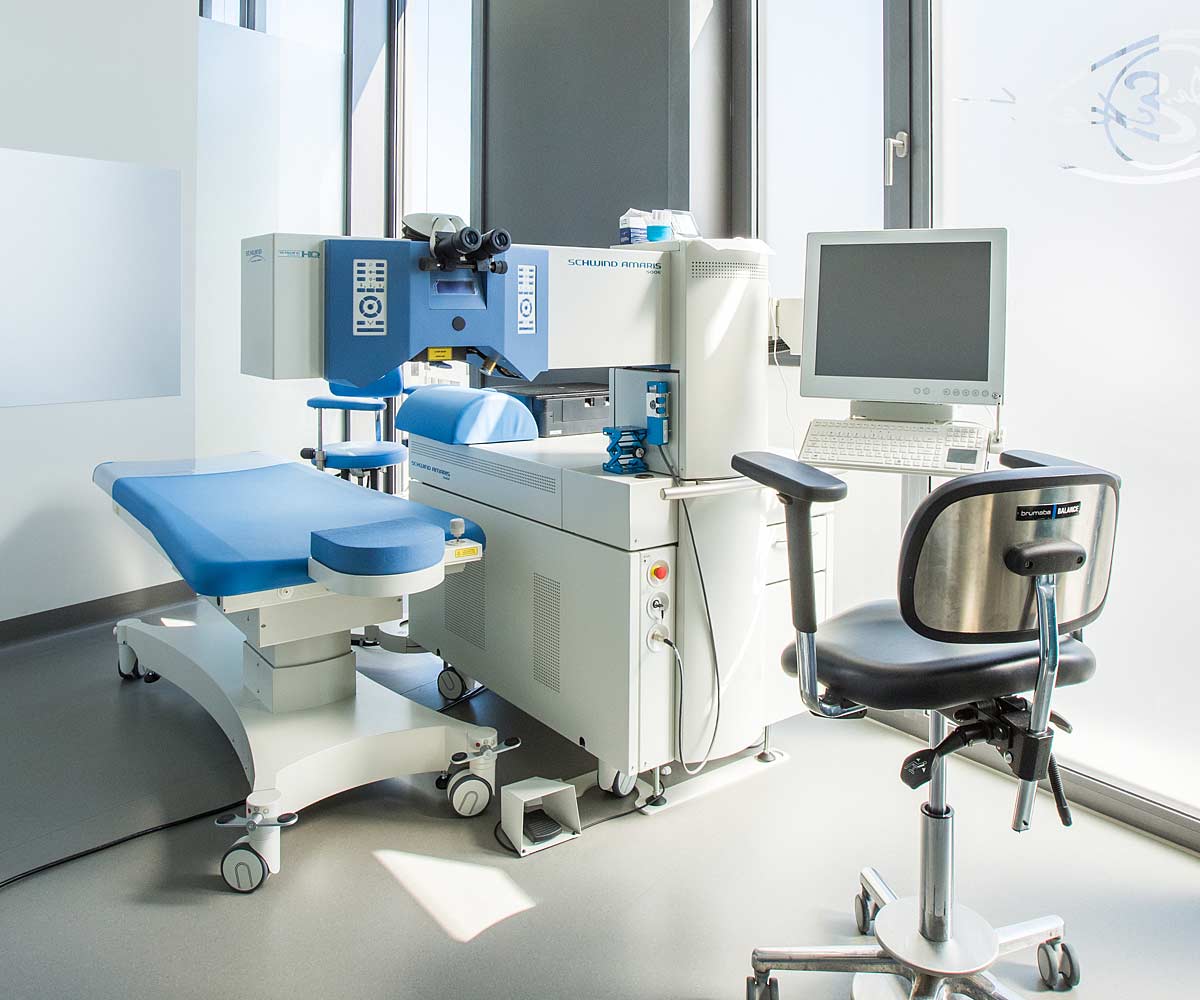
Within our large, modernly equipped surgical centers, we offer you not only the expertise of our team but also state-of-the-art, up-to-date medical technology in the field of ophthalmology.
In justified cases, our eye surgery shuttle can also take you to one of our surgical locations for a fee.
Informational evenings
Are you unsure which treatment method is right for you and would like to get to know Augenzentrum Eckert better? Then we warmly invite you to one of our free informational evenings about cataracts.
We are happy to assist you.